
Buena Vista City Former Property Owners: Where the Trail Starts
Every backward search in Buena Vista City begins with a deed you can trust. From that starting point, you read the grantee name and hunt for the instrument that party acquired the land through. Take the grantor as your next link. The city's online index handles recent instruments. Older transfers are a different story. The clerk's public page names no first year for electronic coverage, so the break point is never a guess you can make from home. For the earliest deed records, the Library of Virginia catalog lists the original deed books. It also lists the index reels. Set the locality correctly and compare the legal description at every step.
| Source | Years It Covers | Where Held | What It Shows |
|---|---|---|---|
| Virginia SRA and clerk index | Current electronic years; first year not published | Buena Vista Circuit Court Clerk / SRA | Indexed parties and recording references |
| Deed Books 1–48 | 1892–1972 | Library of Virginia cataloged reels | Recorded instruments for older chains |
| General and grantor indexes | General index through 1948; grantor segments through 1986 | Library of Virginia | Name-to-instrument research path |
| 1892 City Plat and planning maps | Historic map; later materials vary | Buena Vista Community Development | Lot, street, and subdivision context |
A recent Buena Vista City chain is easiest to build. Start in the Secure Remote Access index. Ask the clerk to confirm exactly how far back that local coverage runs. An index result may fall before the online range. Pull the cataloged deed book for that year. Or use the reel covering it instead. A plat can help you match a historic lot to a modern address. It is not proof of a conveyance on its own.
Buena Vista City Former Property Owners: Trace Each Grantee to Grantor
One deed at a time is the only way a chain holds together. Take the latest grantee you can verify in Buena Vista City property records. Find the deed by which that owner acquired the land. The grantor on that instrument becomes your next search target. Log the parties at every step. Include the date, the deed reference, and the legal description in a running timeline. Stop when you reach the era in question. Stop as well when the trail moves into a historical volume that is not online.
- Find a deed in which the known owner appears as grantee.
- Record the grantor, date, recording citation, and property description.
- Search the grantor as a prior grantee and check that the parcel description continues.
- When the online search ends, continue through the corresponding Library of Virginia index and deed book.
- Grantor / grantee
- The transferor and recipient named in the recorded instrument.
- Chain of title
- The ordered series of instruments associated with the same parcel.
- Legal description
- The recorded land description, often more useful than a later street address.
Buena Vista City Former Property Owners: How Far Deed History Reaches
The archival reach of Buena Vista City deed history is impressive. Library of Virginia collections document deed books beginning in 1892. Supporting indexes carry into the twentieth century. The clerk's public pages never state a current start year for the online index. That means no verified electronic cutoff exists to quote here. Ask the Circuit Court Clerk directly where indexing begins. Then bridge the earlier years with the archival catalog. A search may bump into a portal limit. That has not reached the end of the deed records.
Lawful use. Former-owner research supports property history, title review, and legitimate diligence. Do not use records to track, threaten, or harass a living person; obtain title and boundary conclusions from qualified professionals.
Buena Vista City Former Property Owners: The Historic Index Through 1986
Buena Vista City publishes no start year for its present online deed index. The catalog tells a different, richer story. Library of Virginia holdings list general deed indexes through 1948 and grantor-index segments running through 1986. Ask the clerk where electronic coverage begins. Never assume an electronic result is a complete historical chain just because it returns several Buena Vista transfers. For each prior owner of record, label the source. Note whether the deed came from the local index, an original deed book, or an archival index reel. That label matters when someone needs to repeat the search or close a gap. The online cutoff is a question for the clerk. It cannot be inferred from the catalog.
Buena Vista City Former Property Owners: Deed Books 1 Through 48
Library of Virginia locality materials identify Buena Vista Deed Books 1 through 48. These volumes cover 1892 to 1972. The same catalog separately documents Deed Books 1 through 6 for 1892 to 1904. It also lists other supporting indexes. Ranges like these give a researcher a concrete next step whenever a former owner predates the modern digital index. Ask the library or the clerk which volume and index reel match the transfer year. Then use the grantee and grantor entries to reach the deed page itself.
Record the reference before requesting an image. An index entry names parties and points to a volume; the deed image is needed to read the actual land description and conditions. The Buena Vista catalog entry lists the holdings. 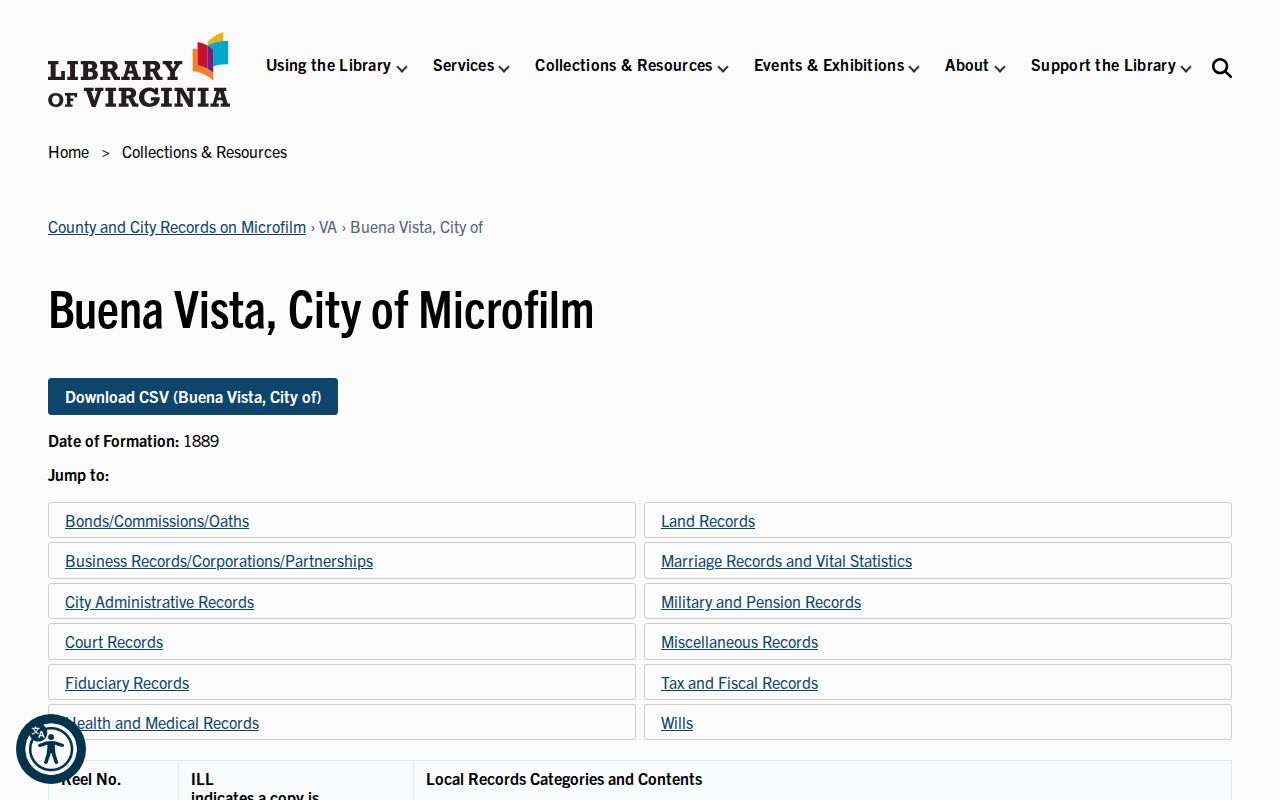 The image shows the archival series available to continue former-owner research.
Buena Vista City Former Property Owners: Walk Back to the Earlier Grantor
Every recorded conveyance is a single link. Start from a known deed. Record the grantee, grantor, date, book and page, and legal description. Then search for the deed in which that earlier grantee bought the land. Repeat until the chain reaches the period you need. Each instrument must describe the same parcel. Watch for a lot that was split or combined, since the legal description can change and the chain may branch.
- Use the latest deed to identify the grantee and the land described.
- Search that grantee in the older index and locate the acquiring instrument.
- Check the acquired description against the later deed for continuity.
- Record each citation and move to the matching historic book when online coverage ends.
Search each name in both grantee and grantor roles. That catches later transfers and earlier acquisitions alike. An index match alone never proves two Buena Vista deeds concern the same parcel.
Buena Vista City Former Property Owners: Use the 1892 Plat for Older Names
Buena Vista was laid out in 1889 and incorporated as a city in 1892. The planning office links an 1892 City Plat Map. That document can tie older lot descriptions to the original street grid. Historic deeds often identify a lot by plat reference rather than by any modern street address. Use the original lot label, then compare it against later deeds. A renumbered or renamed street should not break the search. The city map is a historical aid, not a title document. A recorded deed remains the conveyance source. A survey may be needed to place a line on the ground. For land described before the city existed or before a boundary change, confirm whether the older instrument was recorded in the parent Rockbridge County area.
Estate Files and Cemetery Indexes Can Clarify Family Names
A death can reshape a deed trail fast. A later transfer may name an executor or a fiduciary. It may also name an estate rather than a familiar owner of record. The Buena Vista catalog includes wills and fiduciary settlements. It also lists Green Hill Cemetery indexes alongside the deed books. These materials explain spelling shifts or the timing of a family transfer. They never replace the recorded deed that conveyed the parcel. Keep the estate citation and the land-record citation together for a title professional to review.
Virginia vital-record rules also matter for genealogical support: birth records become public after 100 years, while death, marriage, and divorce records become public after 25 years. Current certified records have eligibility rules. Virginia’s genealogy guidance explains public periods and archival access. 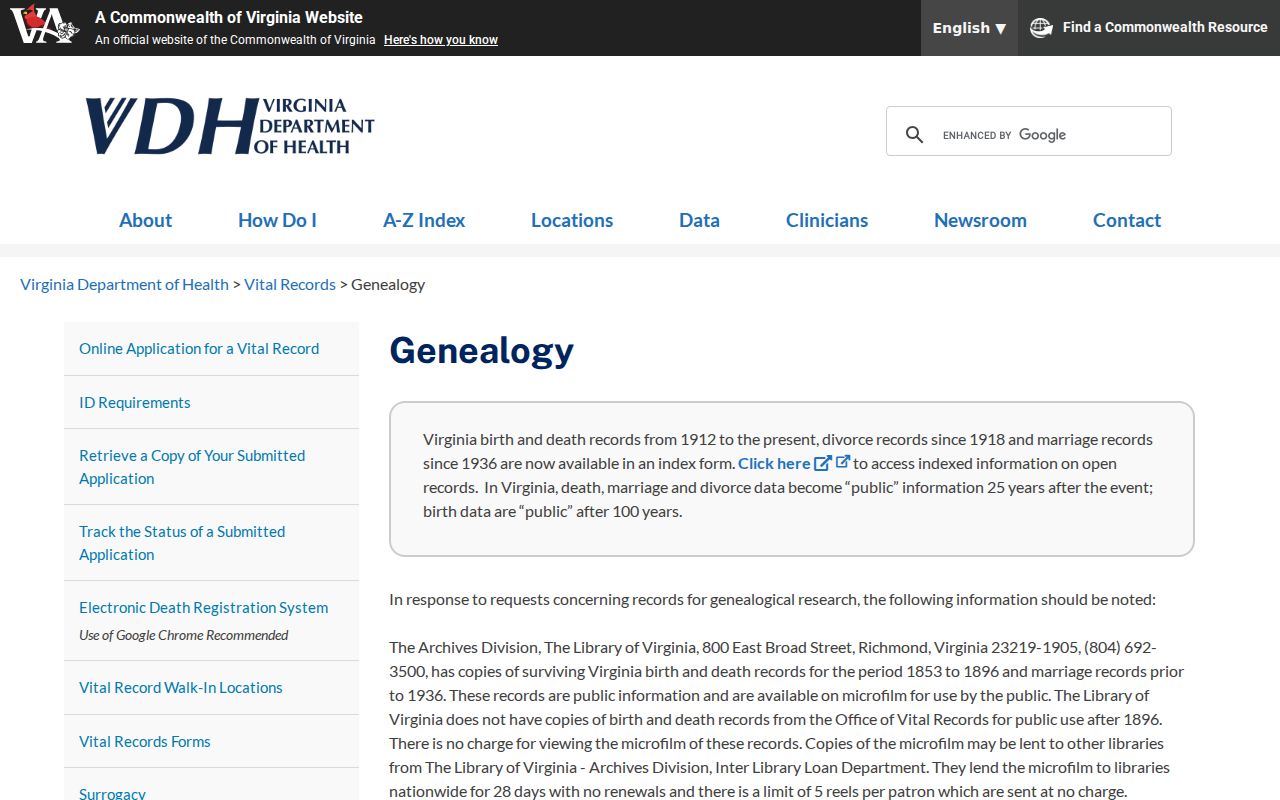 These records can help with historic names, but the deed remains the property-transfer evidence.
The state’s online vital-record request page displays the certificate types available for application, including marriage, divorce, birth, and death records. 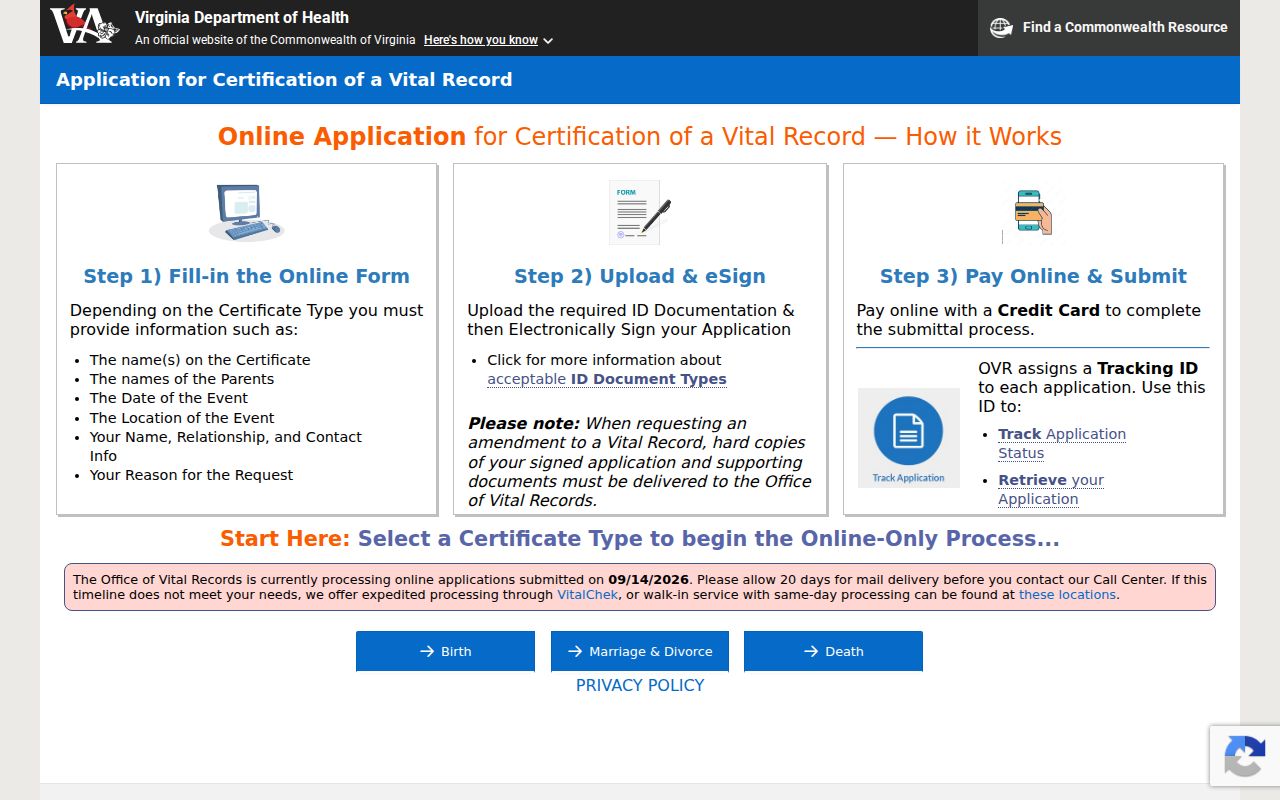 The screenshot is a request route for eligible records; it does not establish a property transfer or replace the deed chain.
The Former Dickinson Rail Spur Is a Separate Chain Problem
One odd case in Buena Vista City shows why property records demand close reading. A 2026 council packet describes an abandoned 50-foot-wide fee-simple rail spur. The spur was tied to the Dickinson Fire Brick Company. The narrow tract ran across what are now streets. Structures went up over parts of it. Habitat for Humanity held an interest and paid the tax bill on it. City staff weighed accepting that interest, hoping to settle unclear ownership of record. They also wanted to keep the land open for alley, utility, or stream-maintenance use.
A rail spur like this teaches a lesson. Follow the legal description, not the street address. A linear tract can have a grantor-grantee chain all its own. That chain is separate from the lots around it. Council packets, right-of-way records, tax roll entries, and deed records each hold a piece of the story. The packet records a discussion, not a final ruling on every affected title. For that, the recorded instruments and a qualified title review are the real answer.